





A wooden cat tree is one of the best “quality-of-life upgrades” you can make for indoor cats. It gives them vertical territory (which many cats naturally crave), a safer place to scratch, and dedicated spots to nap, perch, and observe their environment—without sacrificing your sofa or curtains. Compared with all-plush towers, wooden designs tend to look more like real furniture, are easier to wipe clean, and often feel sturdier under energetic jumping.
Costway UK’s cat tree range includes compact towers for small flats, mid-height options for kittens and young cats, and larger multi-level activity centres that combine condos, hammocks, perches, and scratch zones in one footprint.
1. Start with your cat’s behaviour (not just the height)
Before you pick a wooden cat tree, consider how your cat actually uses space:
• Climbers & lookouts: Cats that love shelves, wardrobes, or windowsills usually prefer taller trees with stable platforms and at least one elevated lounging spot.
• Burrowers & shy cats: If your cat hides under beds or behind sofas when stressed, prioritize a covered condo (or multiple hideouts) to create a secure “safe room.”
• Scratchers first, loungers second: Some cats treat cat trees mainly as scratch stations. For these, the scratching material and post design matter more than the number of beds.
• Kittens vs. adults vs. seniors: Kittens enjoy more levels and toys; seniors often prefer fewer, wider steps and stable perches.
If you’re buying for two or more cats, plan for “traffic flow”: more than one route up/down, multiple resting areas, and enough surface area so one cat can’t guard the entire tower.
2. Understand what “wooden” really means (and why it matters)
Many “wooden cat trees” use engineered wood or composite boards with a wood-look finish, sometimes paired with natural elements (like woven cattail baskets) or metal frames. Engineered boards can be very stable when thick enough and when paired with a wide base; they also tend to be smoother and easier to wipe clean than fully carpeted cat trees.
For example, Costway’s 121 cm wooden/cattail design uses 15 mm engineered board for durability and stability, plus a wide, balanced base for safe jumping.
This matters because the #1 reason people stop using a cat tree is wobble. Cats notice instability immediately and may avoid it—or jump in a way that increases tip risk.
What to look for
• Board thickness and solid connections between levels
• A wide base relative to overall height
• Strong support posts where cats land and turn
3. Stability and safety: the non-negotiables
A good wooden cat tree should feel stable even when your cat launches onto it at full speed.
Key stability signals
• Wide footprint: Larger base = lower tipping risk.
• Multiple support points: More than one post supporting big platforms or hammocks.
• Anti-slip footpads (or similar features) are a bonus for hard floors.
Costway’s tall wooden model highlights thickened boards, a wide base, and anti-slip footpads designed to reduce wobble when cats jump.
The compact 2-tier model is designed around a spacious base and is rated to support up to 20 kg, which is helpful if you have a bigger cat or two cats that occasionally share the perch.
Home placement tip (often overlooked): Put the tree where your cat already wants to be—near a window, by the sofa, or in a common room. A “perfect” cat tree in the wrong location becomes expensive décor.
4. Scratching surfaces: sisal vs. boards vs. “full wrap”
Scratching isn’t “bad behaviour”—it’s normal maintenance and stress relief. The goal is to give a better option than your furniture.
What to evaluate
• Material: Natural sisal (rope or cloth) is common and usually well accepted.
• Coverage: Full-wrap posts are typically more satisfying than partial sections.
• Height variety: Cats like to stretch; different post heights help.
Costway’s tall wooden cat tree emphasises fully sisal-covered thicker posts plus an extra scratching board—useful for cats that scratch hard and often.
The 2-tier option uses a sisal plate (engineered wood wrapped in sisal cloth), which can work well in small spaces and still protect furniture.
5. Comfort and hygiene: cushions, baskets, and easy cleaning
Cats won’t love a tree that feels slippery, cold, or uncomfortable. For wooden cat trees, comfort usually comes from cushions, plush pads, hammocks, and baskets.
Best practice features
• Removable, washable cushions (especially on the top perch)
• Breathable materials for warmer homes or cats that overheat
• Raised-edge beds for cats that like to curl up
The 121 cm cattail-fluff model stands out here: it includes a breathable hand-woven cattail basket and multiple lounging zones (bed + hammock + condo) with removable/washable cushions.
The tall wooden cat tree also highlights detachable, hand- or machine-washable pads, plus wipe-clean wooden surfaces—excellent for keeping fur, dander, and tracked litter under control.
6. Size planning: match the tower to your space and your cat
Instead of guessing, use a quick checklist:
• Measure your available footprint (L × W) and height clearance (ceiling fans, shelves).
• Check platform spacing: Cats should be able to step up confidently without awkward jumps.
• Pick perch sizes based on your cat’s body: Bigger cats need wider, sturdier platforms.
A practical example: the 121 cm model is 50 × 50 × 121 cm, which is a manageable footprint for many UK living rooms while still giving meaningful vertical space.
3 Recommended Costway Wooden Cat Trees
1) 121 cm Tall Cat Tree Tower with Cattail Fluff Cat Condo
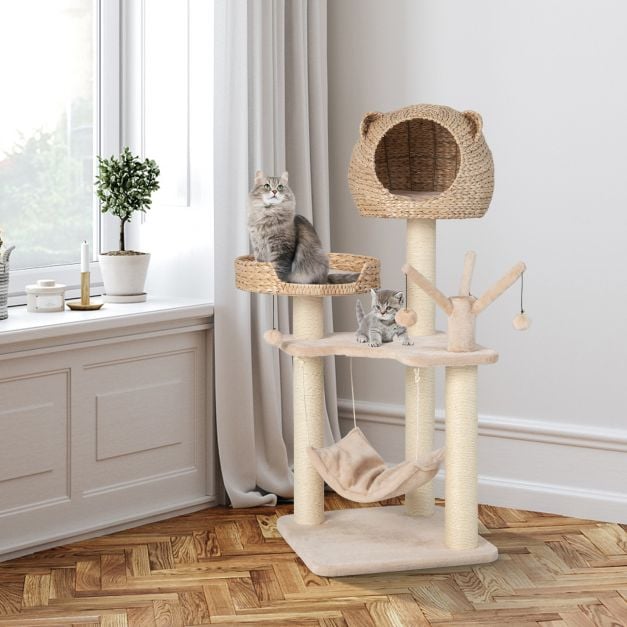
121 CM Tall Cat Tree Tower with Cattail Fluff Cat Condo
Why it’s worth recommending: It combines play + rest + scratching in a balanced, mid-height footprint—great if you want one tower that covers most daily needs.
Highlights
• 5-layer activity centre with hammock, platforms, bed, and a private condo for downtime
• Hand-woven cattail basket/bed elements designed to feel breathable and comfortable
• Multiple sisal-wrapped scratching posts to redirect scratching away from furniture
• 15 mm engineered board + wide base to support confident jumping
Best for: kittens, young cats, or single-cat homes that want a “complete station” without going extremely tall.
2) 2-Tier Cat Tree with Sleeping Perch Sisal Scratching Plate and Ball
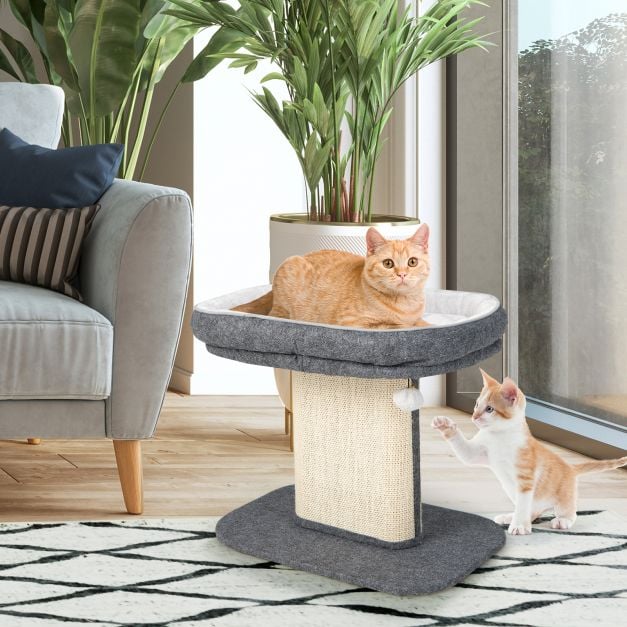
2-Tier Cat Tree with Sleeping Perch Sisal Scratching Plate and Ball
Why it’s worth recommending: If you have limited space (or you’re adding a second station in another room), this is a clean, minimalist perch-and-scratch setup that still feels functional.
Highlights
• A spacious top perch for sunbathing, napping, and “supervising” the room
• Sisal scratching plate + hanging ball to support play and claw care
• Removable, washable cushion to keep the resting area clean
• Stable base designed to support up to 20 kg
Best for: flats, smaller rooms, adult cats that mainly want a perch, or owners who want a low-assembly option.
3) Tall Cat Tree with Hammock Condo and Sisal Scratching Posts

Tall Cat Tree with Hammock Condo and Sisal Scratching Posts
Why it’s worth recommending: This option focuses on comfort zones and serious scratching capacity—ideal for cats that alternate between bursts of energy and long naps.
Highlights
• Multiple rest areas: top hammock, side perch, bottom condo, plus jumping platforms
• Thickened boards + wide base to reduce wobble during energetic climbing
• Fully sisal-covered thicker posts plus an extra scratching board for more scratch “real estate”
• Removable, washable pads and wipe-clean wood surfaces for easier maintenance
• Extra cat-friendly details like a self-grooming brush and rounded corners/ventilation holes
Best for: cats that scratch intensely, households that want more lounging variety, and owners who care about easier cleaning.
Practical setup and care tips (helps performance + longevity)
• Introduce gradually: Sprinkle a little catnip (if your cat likes it) or place treats on the first and second levels for a few days.
• Anchor with placement: Position the tree near a wall or corner for extra perceived stability.
• Rotate toys: If the tree includes dangling balls, rotate or temporarily remove them to keep novelty high.
• Clean smart: Vacuum cushions weekly and wipe wood surfaces as needed—this reduces odours and makes the tree more inviting.